

Most roof leaks do not start where you see the water. By the time a brown ring shows up on the ceiling, the actual problem is often somewhere uphill, and on Vancouver Island, that somewhere is very often the chimney.
Not the chimney itself. The flashing around it. That thin band of metal where the chimney punches through the roof is one of the hardest-working and most neglected parts of the whole structure, and when it fails, it tends to do so quietly. No dramatic drip. No obvious damage from the ground. Just a slow path for water to follow, season after wet season, until it finally reaches somewhere you notice.
If you own a home here with a chimney, this is worth understanding before the next stain appears.
What Chimney Flashing Actually Does
Flashing is the metal that seals the joint between the chimney and the roof surface. A chimney is essentially a hole cut into your roof with masonry built around it, and that joint is a natural weak point. Water wants to get in there. Flashing is what stops it.
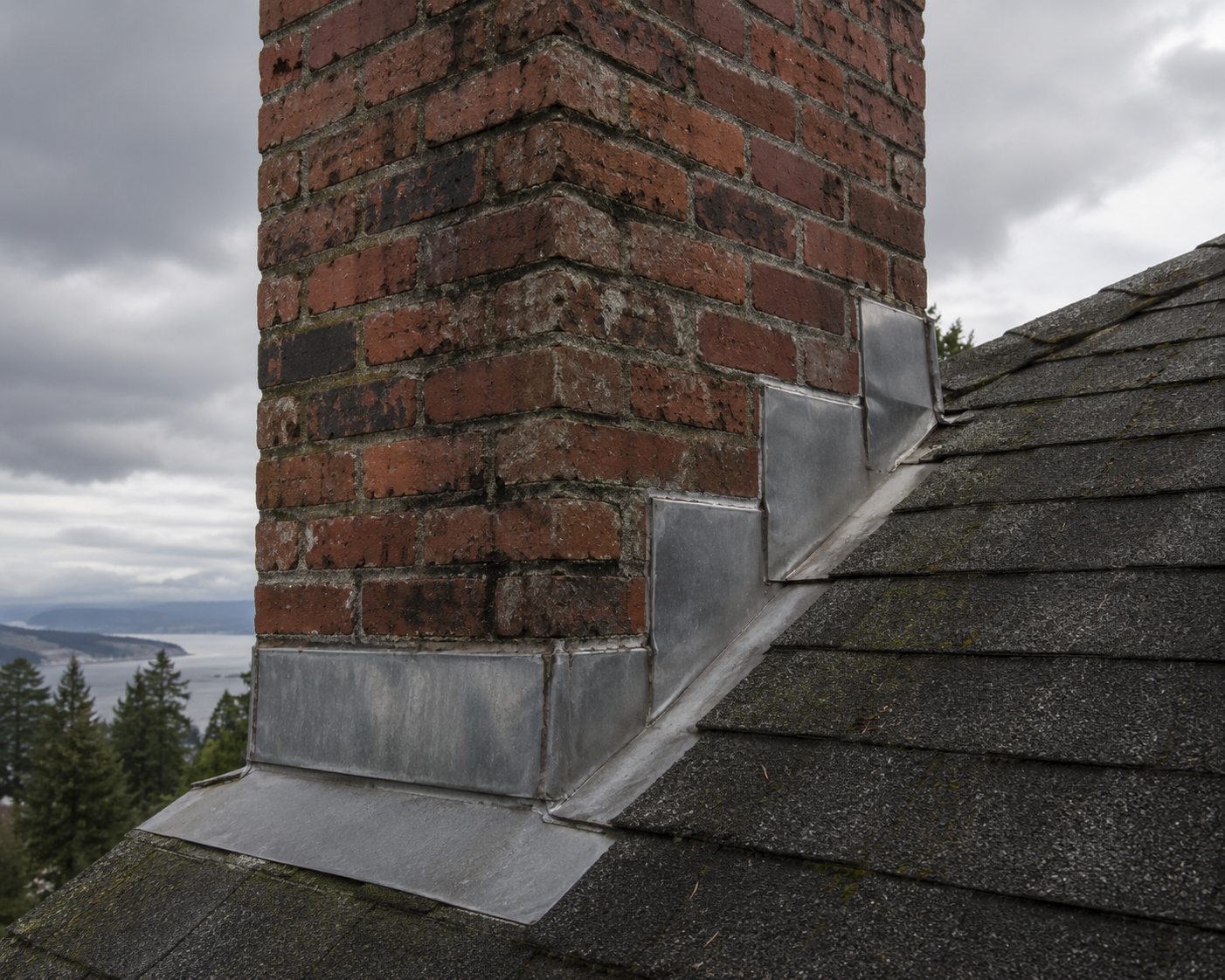
A proper flashing job is not one piece of metal. It is layered. Step flashing runs up the sides in overlapping pieces tucked under each course of shingles. Counter flashing is set into the chimney’s mortar joints and folded down over the step flashing, so water sheds outward rather than slipping behind. Done right, it is a small piece of craftsmanship. Done poorly, or left to age, it becomes the most reliable leak in the house.
That layered design is also why a quick smear of sealant rarely fixes a real flashing problem. More on that shortly.
Why It Fails So Often on Vancouver Island
Our climate is hard on flashing in a specific way. It is not extreme cold or blistering heat that does the damage here. It is persistence.
Months of steady, wind-driven rain find any gap and exploit it. The constant wet-dry cycling works at sealant and lifts metal edges over time. Older homes, of which the Island has plenty, often have flashing that was installed decades ago, sometimes with materials or methods that have long since aged out. And a lot of Island chimneys sit on the weather side of the house, taking the full brunt of every system that rolls in off the water.
Add moss, which loves the damp shade near a chimney and holds moisture against the roof, and you have close to ideal conditions for slow flashing failure.
The Signs of Failing Flashing
This is the part homeowners miss, because the early signs do not look like a roof problem. They look like a wall problem, or a paint problem, or nothing at all.
Watch for these:
• Water stains on the ceiling or wall near the chimney, often appearing only after heavy or prolonged rain.
• Discoloured or peeling paint and wallpaper around the chimney breast inside the house.
• Visible rust, gaps, or lifted edges on the metal where the chimney meets the roof.
• Crumbling or missing mortar where the counter flashing sits in the chimney joints.
• A damp or musty smell in the attic, or visible moisture on the underside of the roof deck near the chimney.
• Dampness on the chimney masonry itself that lingers long after the rain stops.
The tell that points specifically at flashing rather than something else is timing and location. If the leak shows up near the chimney and tracks with heavy rain, flashing is the first suspect. Light rain often is not enough to breach a small flashing gap. Heavy, sustained rain is, which is why so many Island homeowners first notice the problem in the depths of winter.
Reseal, Repair, or Replace: The Honest Version
Search how to fix chimney flashing and you will find a hundred videos telling you to grab a tube of sealant. Sometimes that is the right call. Often it is not, and knowing the difference saves you from paying twice.
Resealing makes sense when the flashing itself is sound and the failure is limited to dried-out caulk at the counter flashing or a small gap in an otherwise solid system. A quality flashing sealant can buy real time here. It is a maintenance step, not a cure.
Repair makes sense when a section of flashing is damaged or a few pieces have lifted, but the overall installation is correct. A roofer can replace the affected pieces and re-integrate them with the existing system.
Replacement is the answer when the flashing was installed poorly to begin with, when it has corroded through, or when resealing has already been tried and the leak came back. This is the situation a lot of Island homeowners end up in, because the early resealing only masked a system that was never going to hold.
Here is the trap. Sealant over failing flashing looks like a fix for a season or two. Then the water finds a new path, and now you are dealing with the original problem plus whatever rot grew underneath while you thought it was handled. Water damage rarely stays small for long.
If a flashing leak comes back after a reseal, stop resealing. That is the roof telling you the system needs proper work.
What Good Flashing Looks Like
You do not need to be a roofer to do a rough visual check from a safe vantage point. Properly done flashing is layered and tidy. The step flashing tucks neatly under the shingles, the counter flashing is set cleanly into the mortar rather than just glued onto the surface, and there are no large beads of caulk doing the job that metal should be doing.
If what you see is a thick rope of old sealant smeared around the base of the chimney, that is usually a sign someone took the shortcut. It can work for a while. It is not how a durable flashing system is built.
What Chimney Flashing Repair Costs
Cost depends on what the roof actually needs, which is why an honest assessment matters before anyone quotes you.
A straightforward reseal of sound flashing sits at the low end. Repairing or replacing sections of flashing lands in the mid range. A full flashing replacement, particularly on a larger or harder-to-reach chimney, or one that also needs masonry or mortar attention, costs more. The variable that moves the number most is access and the condition of the surrounding roof and masonry, not just the flashing alone.
Against those numbers, weigh the cost of the leak continuing. Flashing repair is almost always cheaper than the interior damage, insulation replacement, and deck repair that follow a leak left to run.
Will Insurance Cover a Chimney Leak?
This is one of the most searched questions on the topic, and the honest answer is: it depends, and usually not the way homeowners hope.
Most home insurance policies cover sudden, accidental damage, such as water intrusion caused by a storm event. What they typically do not cover is damage that results from gradual wear, deferred maintenance, or a problem that was allowed to develop over time. Failing flashing is, by its nature, a slow process, which puts many chimney leak claims in the grey zone or outside coverage entirely.
The practical takeaway is that you cannot count on insurance to bail out a neglected flashing leak. Catching it early and maintaining it is the only reliable protection. Check your specific policy, and treat any coverage as a backstop rather than a plan.
Common Questions
How long does chimney flashing last?
Quality flashing, properly installed, can last for decades, often as long as the roof it sits on. The sealant component has a shorter life and may need attention every several years, especially in a wet coastal climate. Cheap or poorly installed flashing can start failing far sooner.
How is flashing attached to a chimney?
In a proper job, step flashing is layered under the shingles along the chimney sides, and counter flashing is embedded into the chimney’s mortar joints and folded down over it. The two layers work together to shed water outward. It is mechanically integrated into the structure, not simply stuck on the surface.
Can I just reseal chimney flashing myself?
You can reseal sound flashing if you are comfortable working safely at height, and it can extend the life of a good system. What you cannot do with sealant is fix flashing that has actually failed. If a leak returns after sealing, the system needs proper repair, not more caulk.
What sealant should be used on chimney flashing?
A roofing-grade flashing sealant designed for metal-to-masonry joints, not a general-purpose caulk. That said, sealant is a maintenance layer over a working system, never a substitute for correct flashing. The product matters less than whether the underlying flashing is sound.
How do I know if it is the flashing or something else?
Location and timing are the clues. A leak that appears near the chimney and worsens with heavy, sustained rain points strongly at flashing. A proper inspection confirms it by checking the flashing layers, the mortar joints, and the surrounding roof together.
Who Repairs Chimney Flashing?
A roofing company handles flashing as part of roof repair. On Vancouver Island, where flashing failure is common, it is one of the more routine repairs a roofer carries out. For leaks involving the masonry or mortar as well, the roofer can advise whether a mason needs to be involved.
Catch It Before It Reaches the Ceiling
Chimney flashing is the kind of problem that is cheap and simple to address while it is still just metal and sealant, and expensive once it becomes drywall, insulation, and a soft roof deck. The homeowners who get caught out are not careless. They simply never had a reason to look up at the one part of the roof that fails the most quietly.
If you have noticed staining near a chimney, a damp smell in the attic, or you just want the flashing checked before the next wet season, The Roof Pro inspects and repairs chimney flashing across Nanaimo and Central Vancouver Island. Book an assessment at theroofpro.ca and find out whether it is a quick reseal or something that needs proper work, before the water decides for you.