

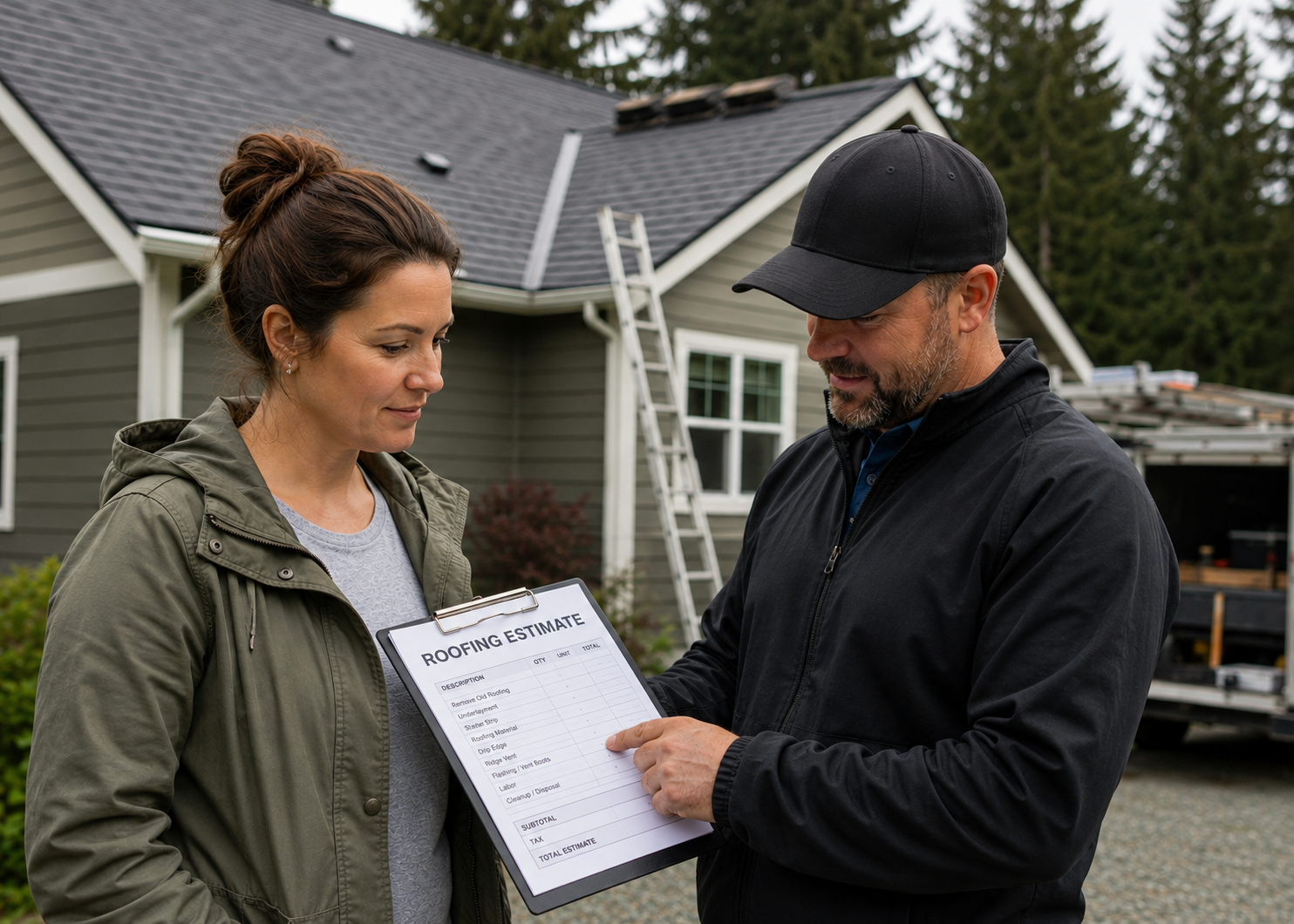
Get three roofing quotes on the same job and you will sometimes get three very different numbers. That gap makes people nervous, and it should, because a quote is only useful if you know what is actually in it. On Vancouver Island, where coastal moisture and moss growth punish a cheap roof fast, the difference between a low bid and a properly scoped one can show up in your attic within a few winters.
This is a walkthrough of what a real roofing quote should include, the line items that tell you a contractor is being straight with you, and the shortcuts that tend to cost homeowners later.
Start with the scope, not the price
The number at the bottom of the page is the easiest thing to compare and the least useful one on its own. Before you look at price, check whether the quote actually describes the job. A solid roofing quote should specify the roofing material and brand, the underlayment type, whether existing shingles are being torn off or covered over, flashing details around chimneys and vents, and ventilation work if any is planned.
If a quote just says ‘reroof house, asphalt shingle, $X,’ you have no way to compare it against a competitor’s quote that lists everything above. Ask for the scope in writing before you compare dollar figures.
Tear-off versus overlay
One of the biggest cost drivers on a quote is whether the old roof comes off first. An overlay, where new shingles go directly over the old layer, is cheaper and faster, but it traps moisture underneath and voids most manufacturer warranties. On the Island, with our rain volume, overlays age poorly. A full tear-off costs more up front because it includes disposal, but it lets the crew inspect the deck underneath for rot before anything new goes on.
If one quote is noticeably cheaper than the others, check whether it is quietly proposing an overlay while the others assume tear-off. That single line explains a lot of price gaps.
Deck repair should be a line item, not a surprise
Plywood decking under old shingles sometimes has soft spots or rot, especially around valleys and chimneys where water collects over the years. A contractor cannot know exactly how much decking needs replacing until the old roof is off, so most reputable quotes include a per-sheet allowance for deck repair rather than a fixed number. What you want to see is a stated rate, something like a price per sheet of plywood if replacement is needed, agreed on before the job starts. A quote with no mention of decking at all is one where you might get a phone call mid-project asking for another two thousand dollars, with no agreed rate to check it against.
Underlayment and ice and water shield
Underlayment is the waterproof layer between the shingles and the deck, and it matters more here than in drier parts of the country. A quote should specify synthetic underlayment (stronger and more water resistant than old-style felt) and should call out ice and water shield membrane along eaves, valleys, and around penetrations like skylights and vent stacks. These are the spots where roofs actually fail first on the Island, and skipping the membrane there is a common place contractors cut cost without telling you.
Ventilation, or the part everyone forgets to ask about
A new roof with no attention to attic ventilation is a roof set up to fail early from the inside. If your current attic has poor airflow, ask whether the quote includes any ridge vent, soffit vent, or baffle work. It does not need to be a huge line item, but if ventilation was never discussed, ask about it before you sign. It is far cheaper to add during a reroof than as a separate job later.
Warranty terms, in plain language
Every quote will mention a warranty, but the terms vary enormously. There are two separate warranties to look for: the manufacturer’s warranty on the shingles themselves, and the contractor’s workmanship warranty on the installation. Ask how many years each one covers, and whether the workmanship warranty is written down anywhere or just spoken. A verbal promise is not a warranty.
Payment schedule and deposit size
A reasonable deposit is normal, materials need to be ordered before work starts. What is worth questioning is a deposit that covers most or all of the job cost before any work begins. A payment schedule tied to project milestones, deposit, then a payment after tear-off and deck inspection, then final payment on completion, protects you if something goes wrong partway through.
Timeline expectations and what affects them
A quote should give some sense of when work could actually start, not just a price. Reputable roofing companies on the Island often book several weeks out during the busy summer and early fall stretch, when most homeowners schedule reroofs to avoid the wet season. If a quote promises to start next week during peak season, that can sometimes mean a crew with a thin schedule for reasons worth asking about, rather than simply good availability. It is reasonable to ask directly how far out their current bookings run and roughly how long the job itself, once started, is expected to take.
Weather also factors into realistic scheduling on the coast. A contractor who commits to a hard date regardless of forecast, rather than building in some flexibility for a wet stretch, is either very confident in their crew’s ability to work through it safely or not being fully upfront about how weather affects a tear-off in progress.
Red flags worth walking away from
- A quote with no material brand or product line specified, just ‘shingles’
- Pressure to sign same day for a discount
- No mention of WorkSafeBC coverage or liability insurance
- A price dramatically lower than every other quote with no explanation for the gap
- Reluctance to put the workmanship warranty in writing
Insurance and licensing: the paperwork that protects you, not just them
Every legitimate roofing contractor working on Vancouver Island should carry liability insurance and be registered for WorkSafeBC coverage on their crew. This is not just a box to check, it directly protects you. If a worker is injured on your property and the contractor is not properly covered, homeowners have in some cases found themselves exposed to liability they never expected. A quote or contract should be able to produce proof of both without hesitation. If a contractor gets vague or defensive when asked, treat that as information.
It is also worth confirming the company is a registered business, not just an individual working informally, and checking how long they have been operating locally. A roofing company that has been doing reroofs on the Island for a decade or more has a track record you can actually verify through references and past work, which matters more here than a slick-looking quote from someone who showed up at your door.
Material specifics that quietly change the price
Beyond the general shingle brand, a few specific details affect both cost and long-term performance enough to be worth asking about directly. The shingle’s wind rating matters on exposed Island properties, where winter storms off the coast can generate gusts well beyond what a standard shingle is rated for. Algae-resistant shingles cost slightly more upfront but resist the dark streaking common on shaded, north-facing roof slopes in our humid climate, which otherwise shows up within a few years on standard shingles. Class 4 impact-rated shingles, while not strictly necessary everywhere on the Island, are worth asking about for properties in areas with significant tree cover, where falling branches during winter windstorms are a real and recurring risk.
None of these upgrades are mandatory, but a quote that never mentions them, and simply defaults to the cheapest standard shingle available, is one where you are not being given the full picture of what your options actually are.
What a properly scoped quote actually looks like
By the time you are comparing quotes side by side, each one should let you answer these questions without calling the contractor back: what brand and type of shingle, tear-off or overlay, what happens if the deck needs repair and at what rate, what underlayment and where the ice and water shield goes, whether ventilation is addressed, what the manufacturer and workmanship warranties actually cover, and what the payment schedule looks like. If a quote answers all of that clearly, the price on it means something. If it does not, the price is close to meaningless, because you do not actually know what you are being quoted for.
Frequently asked questions
Why do roofing quotes vary so much for the same house? Usually because contractors are pricing different scopes, one may be quoting an overlay while another is quoting a full tear-off with deck repair allowance and upgraded underlayment. Same roof, very different jobs.
Is the cheapest quote ever the right choice? Sometimes, if it is scoped the same as the others. Often it is cheaper because it is leaving something out, an overlay instead of tear-off, no ice and water shield, a thinner underlayment, or a shorter workmanship warranty.
How many quotes should I get? Three is generally enough to see the range and spot which one is an outlier, either unusually low or unusually thorough.
Should I ask for references? Yes, and ideally a couple of addresses of recent local jobs you can drive by. A contractor confident in their work will not hesitate to share this.
What is a reasonable deposit amount? Deposits vary, but a common range sits somewhere around ten to twenty percent of the total project cost to cover material ordering, with the balance tied to milestones rather than paid entirely upfront.
Does a written contract matter if I already have a quote? Yes. A quote outlines pricing and scope, but a signed contract is what actually protects both sides if a dispute comes up later. Make sure the final agreed scope, payment schedule, and warranty terms all make it into the contract, not just the quote.
If you have a quote in hand and want a second opinion before you sign, The Roof Pro is happy to walk through it with you and tell you honestly whether it is scoped fairly for the work involved.