

Most homeowners think about their roof from the outside—shingles, gutters, moss on the north slope. Few think about what is happening in the attic above their ceiling, and that is exactly where a lot of roofs start to fail. Poor ventilation traps warm, moist air under the deck, and on Vancouver Island, where humidity is already high for most of the year, that trapped moisture can rot a deck from underneath years before the shingles above it show any wear.
This one gets missed constantly because it is invisible from the street. Here is what is actually going on up there, and how to tell if your attic is working against your roof instead of protecting it.
Why attic airflow matters more here than in drier climates
Every house generates moisture indoors—cooking, showers, laundry, even just breathing. That moist air rises and finds its way into the attic through small gaps around light fixtures, bathroom fans, and attic hatches. In a well-ventilated attic, that moisture gets carried out through vents before it can condense. In a poorly ventilated one, it settles on the cold underside of the roof deck, especially overnight when temperatures drop, and slowly soaks into the plywood.
On the coast, where outdoor humidity rarely lets a damp attic dry out quickly on its own, this cycle repeats through the wet season for months at a stretch. A house in a drier interior climate can get away with mediocre attic airflow far longer than a coastal Island home can.
What poor ventilation actually does to a roof
The damage happens in a fairly predictable order. Moisture condenses on the underside of the deck and on the rafters. Over time this saturates the plywood, causing it to soften, delaminate, or develop black mold and mildew staining visible from inside the attic. The wood loses its structural strength, which means fasteners holding the shingles down have less to grip. In cold snaps, trapped heat escaping unevenly through the roof can also cause ice damming at the eaves, where meltwater refreezes and backs up under the shingles.
None of this shows up as a leak right away. It shows up as a roof that needs replacing at twelve or fifteen years instead of the twenty-five or more it should have delivered, with the shingles themselves often still looking reasonably intact when the deck underneath is already compromised.
The two-sided system: intake and exhaust
Proper attic ventilation works on a simple principle: cooler air needs to enter low and warmer, moist air needs to exit high, creating continuous airflow rather than a sealed pocket. This means two components need to work together.
Soffit vents (intake) These sit under the roof overhang and let outside air into the attic at the lowest point. If soffit vents are painted over, blocked by insulation pushed too far into the eaves, or simply missing, the whole system stalls no matter how good the exhaust venting is.
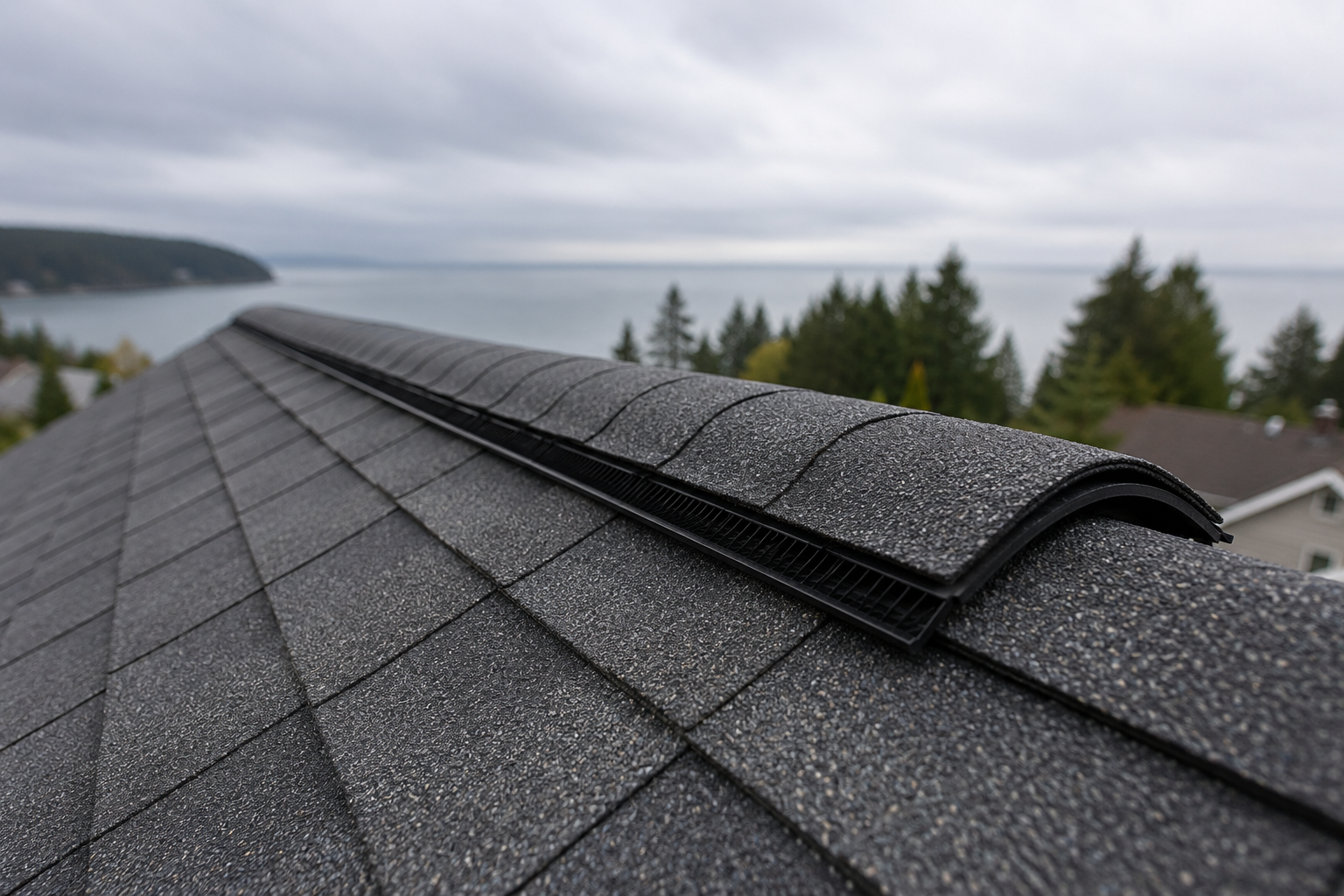
Ridge or roof vents (exhaust) These sit at or near the peak and let warm, moist air escape. A continuous ridge vent along the roofline is the most common and effective option on most Island homes, though individual box vents or a power vent can work depending on the roof shape.
The two need to be balanced. A roof with strong ridge venting but blocked soffits will actually pull conditioned air out of the living space through ceiling gaps instead of pulling in fresh outside air, which makes the problem worse, not better.
Signs your attic ventilation is not working
- Musty smell noticeable when you open the attic hatch
- Visible mold or dark staining on rafters or the underside of the deck
- Frost or condensation on the underside of the roof sheathing in cold weather
- Ice damming along the eaves during cold snaps
- Shingles curling or aging unevenly, often worse on one slope
- Higher than expected heating or cooling bills
Ventilation and roof warranty terms
Something that surprises a lot of homeowners after the fact: many shingle manufacturer warranties include ventilation requirements in the fine print, and inadequate attic ventilation can be grounds for a warranty claim being denied or reduced, even if the shingles themselves failed for what seems like an unrelated reason. Manufacturers know that poor ventilation shortens shingle life from below, through excess heat and moisture, not just from weathering above, so they build minimum airflow requirements into what keeps a warranty valid. This is one more reason ventilation is worth addressing properly during a reroof rather than treating it as optional, since it can directly affect whether a future warranty claim actually holds up.
What fixing it usually involves
In many cases, improving ventilation is a modest add-on to a reroofing job rather than a standalone project. Installing or clearing soffit vents, adding baffles to keep insulation from blocking airflow at the eaves, and switching to a continuous ridge vent are all things that make sense to handle while the roof is already open. Retrofitting ventilation on an untouched roof is possible too, but it is more involved since it means working with the existing shingles rather than building the system in from the start.
The right balance of intake to exhaust venting depends on the size of your attic and your roof’s shape, which is why this is worth having assessed in person rather than guessed at.
Insulation and ventilation are not the same job
A common point of confusion is assuming more insulation automatically means a healthier attic. Insulation and ventilation solve different problems. Insulation slows heat transfer between the living space and the attic. Ventilation manages airflow and moisture within the attic itself. Piling insulation up against the roof deck or stuffing it into the eaves can actually block soffit intake vents, which improves your heating bill slightly while quietly starving the attic of the airflow it needs. The two systems need to be designed together, with baffles specifically installed to keep insulation clear of the vent openings at the eaves.
This is a detail that gets missed even during otherwise competent insulation upgrades, since an insulation contractor is not always thinking about how their work affects roof ventilation, and a roofing contractor doing a reroof is not always checking how much insulation is currently pushed into the eaves. Coordinating the two, or at minimum having a roofing professional check the eaves during a reroof, closes that gap.
How this plays out differently across roof shapes
Simple gable roofs with long, straight ridgelines are the easiest to ventilate well, since a continuous ridge vent paired with matching soffit venting covers the whole attic evenly. Hip roofs, with shorter ridge sections and more complex framing, often need a combination of ridge venting and additional box vents to achieve the same airflow. Roofs with multiple dormers, valleys, or cathedral ceiling sections can create isolated pockets that a single ventilation strategy does not reach, sometimes requiring vents specific to that section rather than relying on the main system to pull air through the whole space.
This is part of why a generic answer to ‘how much ventilation do I need’ does not really exist. The right setup depends on your specific roof’s shape, attic volume, and existing insulation, which is exactly the kind of thing worth having assessed on site rather than estimated from a general rule of thumb.
Frequently asked questions
Can I check my own attic ventilation? You can do a basic visual check—look for daylight or airflow at the soffits, check for staining or mold on the underside of the deck, and note whether insulation is blocking the eaves. A full assessment of whether intake and exhaust are properly balanced is best left to a roofing professional.
Does adding a ridge vent alone fix the problem? Not if the soffits are blocked. Exhaust venting without matching intake venting can pull conditioned air from inside your home instead of drawing fresh air in from outside, which does not solve the moisture problem.
How much does improving attic ventilation typically add to a reroof? It varies by roof size and existing conditions, but it is generally a modest addition compared to the cost of the reroof itself, and far cheaper than replacing a rotted deck later.
Will better ventilation lower my energy bills? Often yes, since a properly ventilated attic keeps summer heat from building up under the roof and reduces the moisture load your insulation has to work against in winter.
How long does it take for poor ventilation to actually damage a roof? It varies widely depending on severity, but on the Island, with our sustained wet season, meaningful deck damage from chronic moisture can develop over just a handful of years in poorly ventilated attics, well ahead of when the shingles themselves would otherwise need replacing.
Is a bathroom fan supposed to vent into the attic? No. Bathroom and kitchen exhaust fans should vent directly outside through a dedicated roof or wall vent, never into the attic space itself. A fan venting into the attic is a significant and often overlooked source of the exact moisture problem this article describes.
If you are not sure whether your attic is helping or hurting your roof, The Roof Pro can take a look during a routine inspection and tell you plainly whether ventilation is something worth addressing.