

Nobody thinks about their gutters in August.
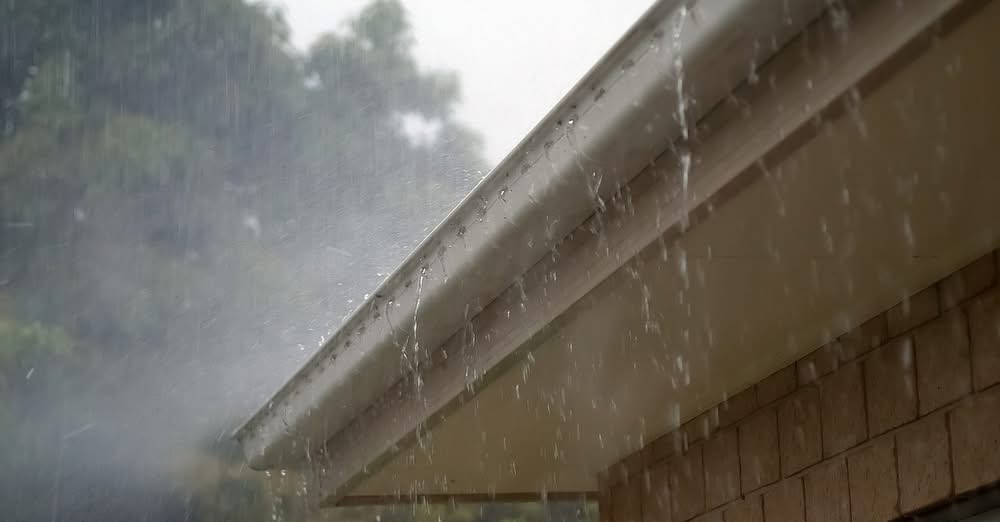
They are dry, quiet, and doing nothing. Then the first real fall system rolls in off the water, the rain starts and does not stop for four days, and suddenly there is a waterfall pouring over the edge of the roof onto the front steps.
By that point, the gutters have probably been full for months.
The fir needles came down all summer. A few maple leaves joined them in September. Add water and you have a wet, packed mat sitting in a metal trough, sending rain everywhere except where it is supposed to go.
Here is the thing most homeowners do not connect: gutters are not landscaping. They are part of the roof system, and when they fail, the roof pays for it first.
On this coast, where the wet season runs long, a season of blocked gutters can do more quiet damage than a windstorm.
What Blocked Gutters Actually Do to a House
A gutter has one job: it catches the water running off the roof and moves it away from the house.
When it is blocked, that water has to go somewhere, and none of the options are good.
It backs up under the roof edge.
Water pooling in a full gutter sits against the lowest course of shingles and the fascia board behind it. Shingles shed water running downhill. They do not handle water sitting against them from below.
Over a wet Island winter, that standing water works into the edge of the deck. This is where fascia rot starts, and fascia rot is the kind of repair that looks small from the ground and is not.
It overflows down the walls.
Water sheeting over the gutter edge runs down siding, finds window trim, and soaks the ground right at the foundation.
Over enough winters, that is how you get damp basements and stained siding on the weather side of the house.
It freezes.
We do not get long deep freezes here often, but we do get cold snaps.
A gutter packed with wet debris freezes into a solid block, and if a thaw follows, meltwater from the roof has nowhere to drain. That combination feeds directly into the ice damming problem covered in our eave protection article.
It adds weight.
Wet debris is heavy. A long run of packed gutter can start pulling away from the fascia, bending hangers and opening a gap between the gutter and the roof edge that lets water in behind it.
Why Island Gutters Clog Faster Than Most
Two words: tree cover.
Most residential properties here sit under or near conifers, and fir and cedar do not drop their needles in one tidy autumn event the way deciduous trees drop leaves.
They shed a little all year and a lot in dry, windy stretches.
Needles are also the worst possible debris for a gutter because they mat together, hold water like a sponge, and slip past most cheap gutter guards.
So the standard advice of “clean your gutters once a year in the fall” does not really hold here.
On a treed Island property, twice a year is the realistic minimum, and homes directly under big conifers often need a mid-winter check as well.
The Fall Gutter Checklist
You can do most of this from a ladder if the house is single-storey and you are comfortable working at that height.
If it is two storeys, steep, or wet, this is a job worth handing off.
Falls from ladders during gutter cleaning are one of the most common homeowner injuries there is, and no gutter is worth it.
- Scoop out all debris by hand or with a gutter scoop, working away from the downspout so you do not pack it in tighter.
- Flush the gutter with a hose and watch the water. It should move toward the downspout and drain freely. Standing water means the gutter has lost its slope or the outlet is blocked.
- Run water down each downspout. If it backs up, the clog is in the pipe, often at the elbow. A plumbing snake or a sharp rap on the elbow usually frees it.
- Check where the downspouts discharge. Water should be carried away from the foundation, not dumped at the base of the wall.
- Look at the fascia behind the gutter for soft spots, staining, or peeling paint. Probe gently with a screwdriver. Soft wood means water has been getting behind the gutter, and that is worth a professional look.
- Check the hangers and brackets. A gutter that has sagged or pulled away needs re-securing before the rain returns, not after.
- While you are up there, glance at the lowest course of shingles. Granules collecting in the gutter are normal in small amounts. Heavy black grit means the shingles are aging and worth an inspection.
What About Gutter Guards?
Honest answer: they help, but they are not the set-and-forget solution the ads suggest, especially under conifers.
Fine needle debris finds its way through or builds up on top of most guard products, and a guarded gutter still needs checking, just less often.
Good quality micro-mesh guards perform the best in needle-heavy conditions and cost the most.
Cheap plastic snap-in screens tend to create more problems than they solve, since debris mats on top of them and water sheets right over the edge.
If your property is heavily treed, think of guards as a way to turn a twice-a-year cleaning job into a once-a-year inspection job.
That is worth something.
It is not zero maintenance.
When Gutters Are Telling You Something Bigger
Sometimes the gutter problem is not really a gutter problem.
A few things worth paying attention to:
- Gutters that overflow even when clean usually mean they are undersized for the roof area, sloped incorrectly, or the downspouts are too few.
- Constant heavy granule buildup points at the shingles, not the gutters.
- Water stains on the fascia or soffit behind a clean gutter suggest water is getting past the roof edge itself, which can mean drip edge or eave membrane issues underneath the shingles.
Any of those are worth having looked at properly because water damage rarely stays small for long.
Frequently Asked Questions
How often should gutters be cleaned on Vancouver Island?
Twice a year is the realistic baseline here, typically late spring after the heavy pollen and needle drop, and again in fall before the rain settles in.
Properties directly under large conifers benefit from an extra check mid-winter.
Can clogged gutters really damage the roof itself?
Yes.
Water backing up in a full gutter sits against the lowest shingle courses and the fascia, and over a wet winter that standing water works into the roof edge.
Rotted fascia and edge deck damage are the usual results, and both cost far more than a cleaning.
Are gutter guards worth it here?
Quality micro-mesh guards reduce how often you need to clean, which has real value on a treed property.
No guard eliminates maintenance entirely, especially under fir and cedar.
Cheap screens are generally not worth installing.
Is it safe to clean my own gutters?
On a single-storey home, on a dry day, with a stable ladder and someone nearby, many homeowners handle it fine.
Two-storey homes, steep sites, and wet conditions are where people get hurt.
If any of that describes your house, hire it out.
The cost is small.
My downspout is clear but water still pools in the gutter. Why?
The gutter has likely lost its slope, usually from a sagging hanger or a bracket pulling loose.
Gutters need a slight consistent fall toward the outlet to drain.
Re-securing and re-sloping is a straightforward fix if caught early.
Get It Done Before the Weather Decides for You
Gutter cleaning is not glamorous work, and that is exactly why it gets skipped.
But it is one of the cheapest things you can do to protect your roof edge, your fascia, and your foundation on this coast.
An hour on a dry September afternoon saves a wet, expensive discovery in January.
If your gutters need more than a cleaning, or you have noticed sagging, staining on the fascia, or overflow that keeps happening even when they are clear, The Roof Pro can take a look while we are inspecting the roof itself.
We serve homeowners across Nanaimo and Central Vancouver Island.
Book a visit at theroofpro.ca and head into the wet season with the whole system, roof and gutters together, ready for it.